Two weeks ago I attended Nashville Healthcare Sessions. One of the main stage panels was The New Economics of Complex Care, hosted by Josh Weisbrod of Bain & Company, with Mike Uchrin of Monogram Health, Benjamin Kornitzer of Aetna, and Sanjay Shetty of CenterWell.
The moderator opened with survey data he admitted was sobering. "It's been a rough run for value-based care," he said. Then he asked the panel what went wrong. They told him. The clinical model underneath it was thin. Too much of the economics depended on coding. Doctors were given financial incentives without care pathways behind them. The numbers were too weak to forecast the risk organizations were taking on. For many primary care physicians, it has meant more administrative work and an uncertain reward.
I was surprised. These are people who run value-based care programs for a living, and they were saying this in front of the whole room.
Granted, the panel went on to defend the model, and did it well. It was still a striking moment, considering how rare it is to hear direct criticism of value-based care, and an acknowledgement that it has not worked, from a stage at a major healthcare conference. The feeling in the room was different from the usual VBC appeasement. For a few minutes there was a sense of honesty, and a recognition of healthcare's worst-kept secret.
The industry is well aware of the inherent flaws in value-based care, but those conversations take place off the record, when the scripts are put away and nobody is pushing talking points. Few organizations are eager to implement it. Fewer want to take on the measurement and reporting it requires. And no one will admit publicly that its financial future depends on a deus ex machina: a layer of AI, still to come, that aligns the systems, the incentives, the data formats, the coding, and the points of care well enough to show value.
It would be wonderful if that happened. It would make good on twenty years of best intentions and noble aspirations. The more depressing possibility is that our efforts have actually made things worse for patients and for the people who pay the bills.
Value-based care has been wildly successful for the businesses that sell services to manage its complexity. And it has been a triumph for the marketing teams employed to shape the conversation around the model. They have sold it as the moral high ground, as the one solution to the industry's problems, and as the only path to a future where patients are at the center and the system is more efficient and effective because of it.
That framing was on the stage too. One panelist described the goal this way: "How do we continue to grow strength in value-based care? Because it will help the payers, it will help the providers, and again, most importantly, helps the patients." The message was clear. The model is what matters. The outcomes will follow.
This singular faith in VBC leaves little room to suggest that another approach could work for patients, that the economics could be simpler, or that an industry with little direct accountability for the price of care could use something as basic as cost accounting. To say any of it is to argue with the better angels of our nature.
When the model delivered neither better outcomes nor lower costs, it fell to marketing to explain why that still counted as success. We stretched the meaning of value until nearly any adjacent social benefit or gain in access qualified. In an ironic twist, the greatest crime fee-for-service ever committed was choosing a name that was far too literal and allowed for very little ambiguity.
Weisbrod himself said the industry is at an inflection point on what value-based care even means, and one panelist allowed that everyone defines it differently.
There was another moment during the conversation I found fascinating. Weisbrod asked the panel a rather direct question: who loses? For the model to create value, he said, somebody has to. One party's cost is another's revenue, and some of it has to go away.
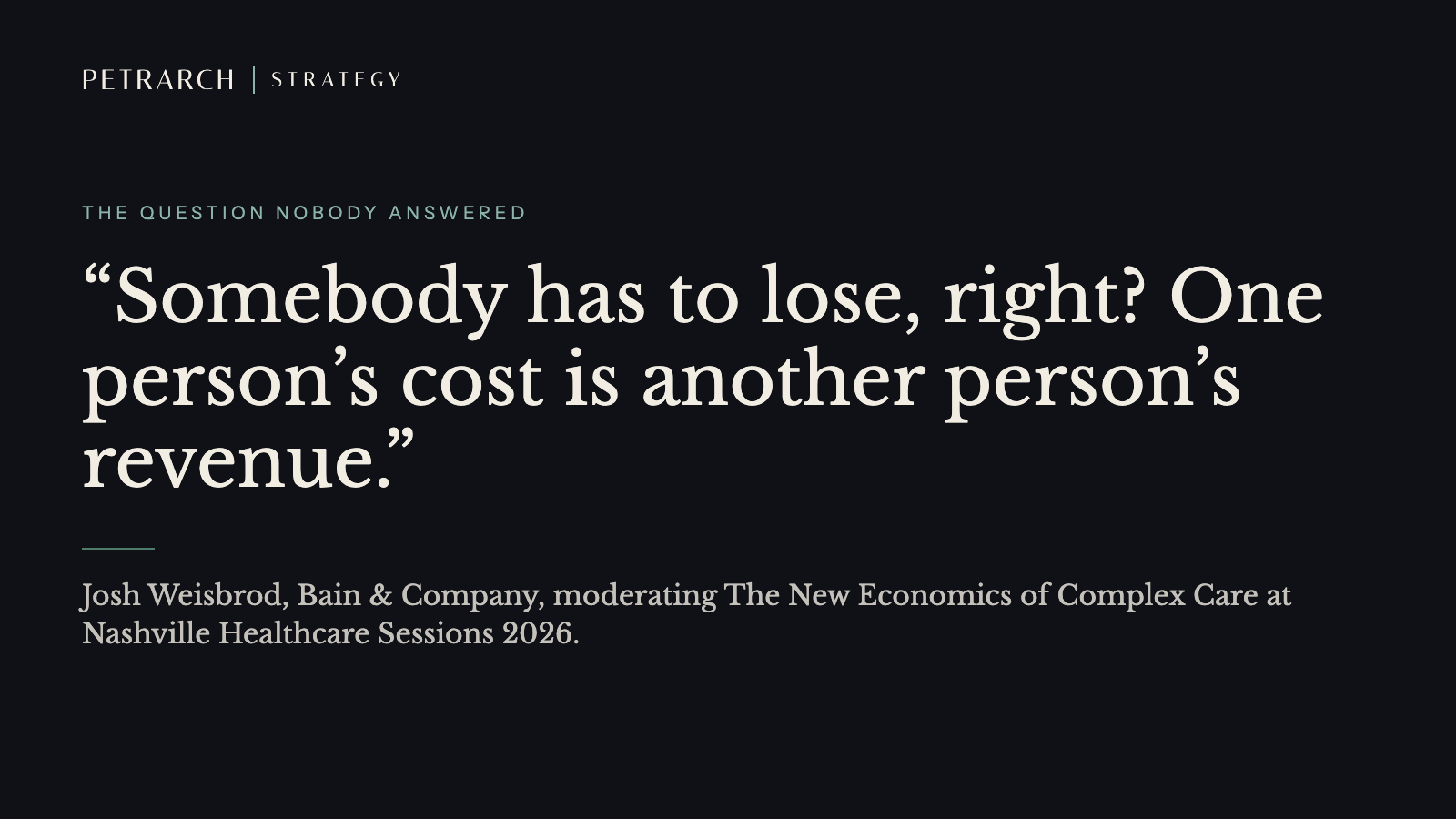
Nobody answered. The panel waited, and the next question was about technology.
If the model ever lowers the cost of care, that money comes out of somebody's revenue. No one on stage said whose.
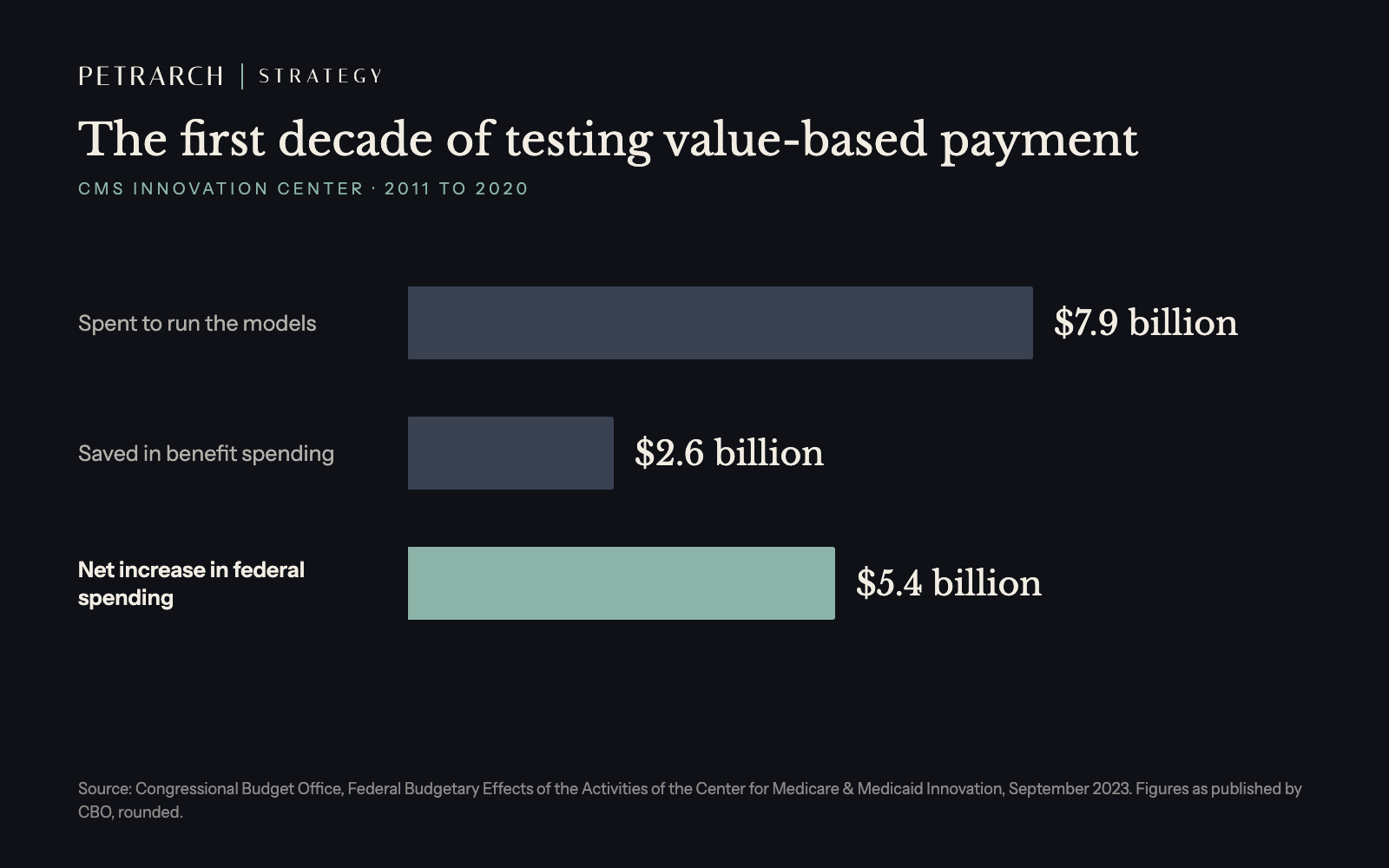
So far the point has been academic. The Congressional Budget Office found that the center created to test these payment models increased net federal spending by $5.4 billion in its first decade. One panelist forecast that 2027 will be a fourth straight year of medical cost growth at or near double digits.
The marketing foundation under value-based care has held for my entire career in healthcare. On a main stage in Nashville, in front of the industry, I could see the cracks.