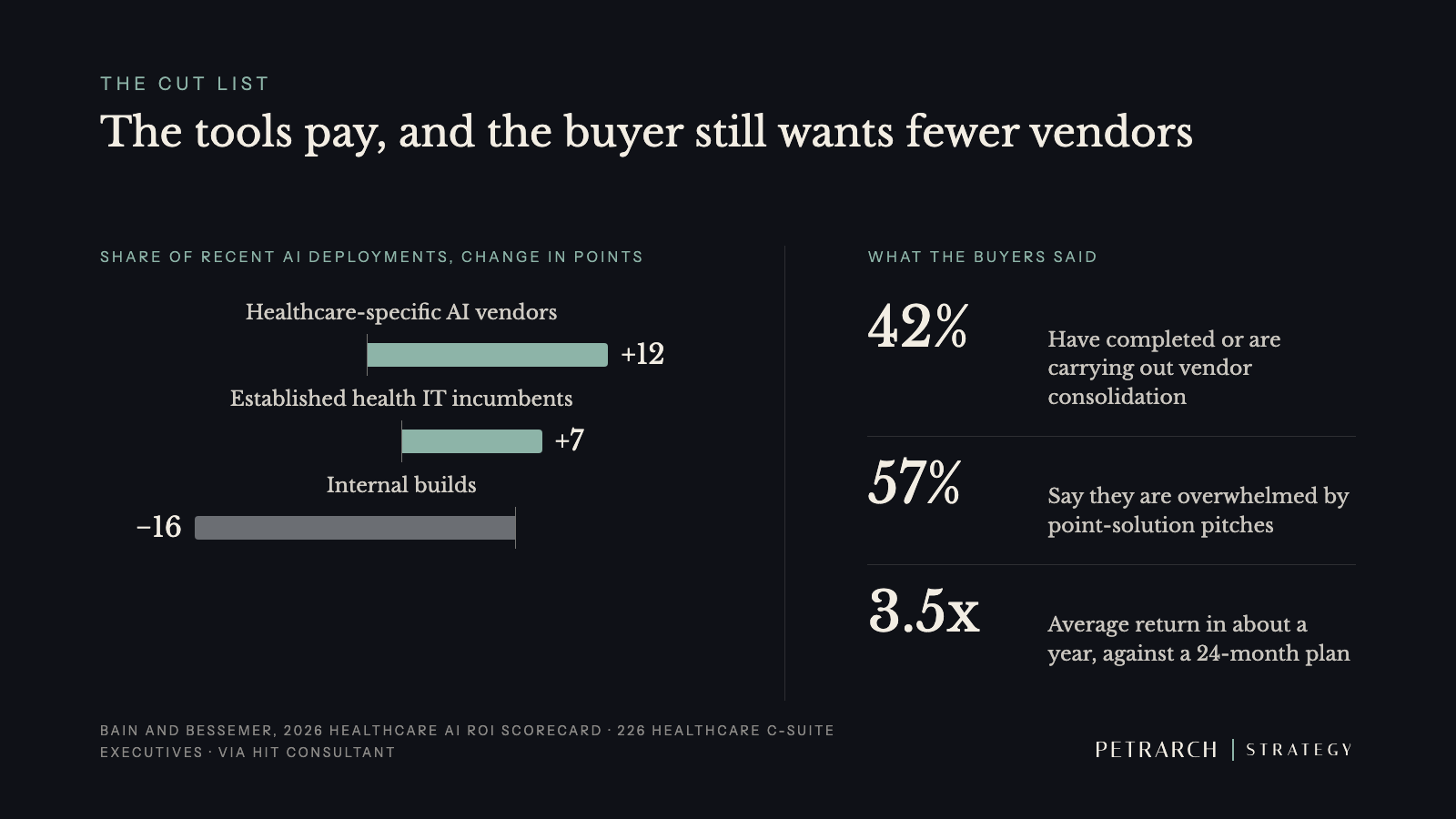
Bain and Bessemer put out a survey this week of 226 healthcare executives on what their AI spending has actually returned. It turns out the money is coming back. The average deployment paid for itself 3.5 times over in about a year, which is twice as fast as the buyers had planned for.
What caught my attention was further down. Four in ten of those executives are in the middle of cutting their vendor lists. More than half said they are overwhelmed by point-solution pitches. The new spending is going to vendors that know healthcare and to the big incumbents already in the building, and it is coming out of the tools the buyers tried to build on their own.
So the technology works, and the people buying it still want fewer companies to deal with. Cigna told its investors the same thing last week. The company is looking for $3 billion in savings by 2030, and one of the three places it plans to find them is "better managing suppliers, partners and vendors." If you sell into healthcare, somebody has your name on a list right now and is deciding whether it stays there.
The vendors that get cut are the ones the committee cannot tell apart.
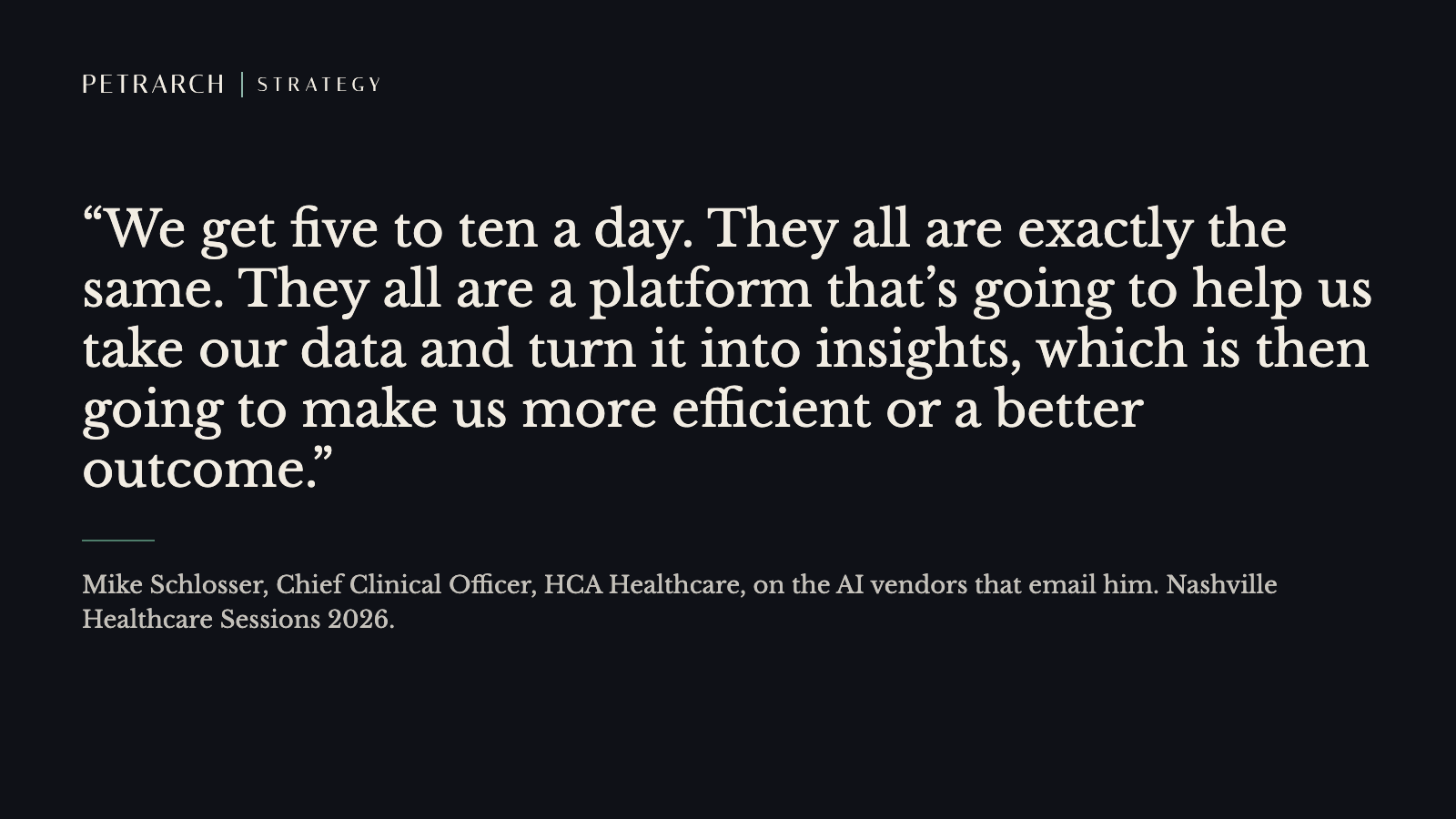
Mike Schlosser, the chief clinical officer at HCA Healthcare, said something close to this from the stage at Nashville Healthcare Sessions last month. He was asked how he screens the companies that approach him, and he started with the volume. "We get five to ten a day. They all are exactly the same. They all are a platform that's going to help us take our data and turn it into insights, which is then going to make us more efficient or a better outcome." What he looks for instead is adoption that keeps growing through a pilot, a value proposition that gets better without pivoting, and people he would want in a room with him for hours working a problem.
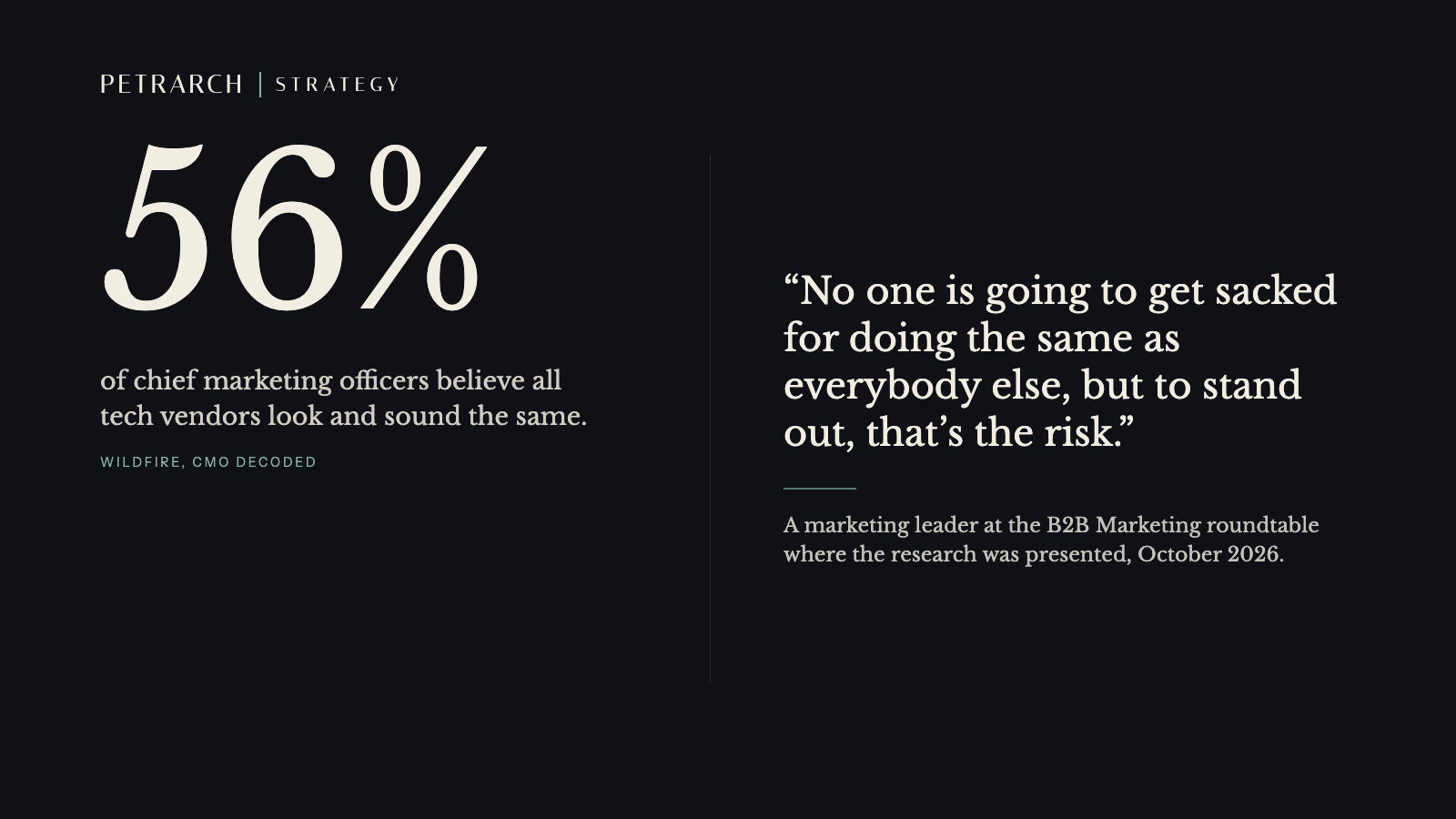
The people writing those emails know it, too. Wildfire, a B2B tech PR agency, presented its CMO Decoded research at a B2B Marketing roundtable the same day the Bain numbers came out. 56 percent of chief marketing officers believe all tech vendors look and sound the same. The reason offered in that room had nothing to do with budgets or channels. "No one is going to get sacked for doing the same as everybody else," one marketing leader said, "but to stand out, that's the risk."
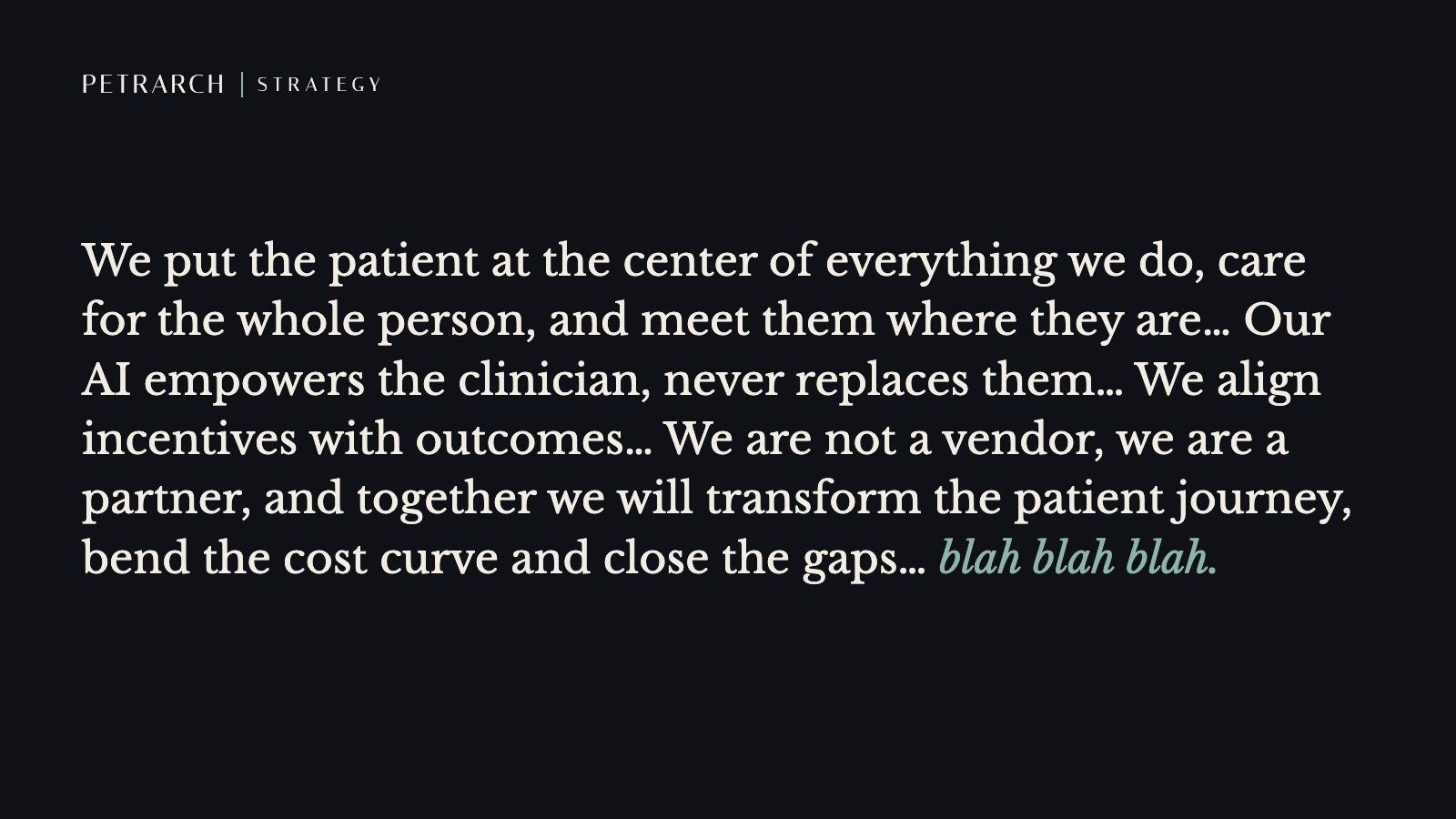
The buyer and the seller agree on the problem. Here is what it sounds like in healthcare. We put the patient at the center of everything we do, care for the whole person, and meet them where they are… Our AI empowers the clinician, never replaces them… We align incentives with outcomes… We are not a vendor, we are a partner, and together we will transform the patient journey, bend the cost curve and close the gaps… blah blah blah.
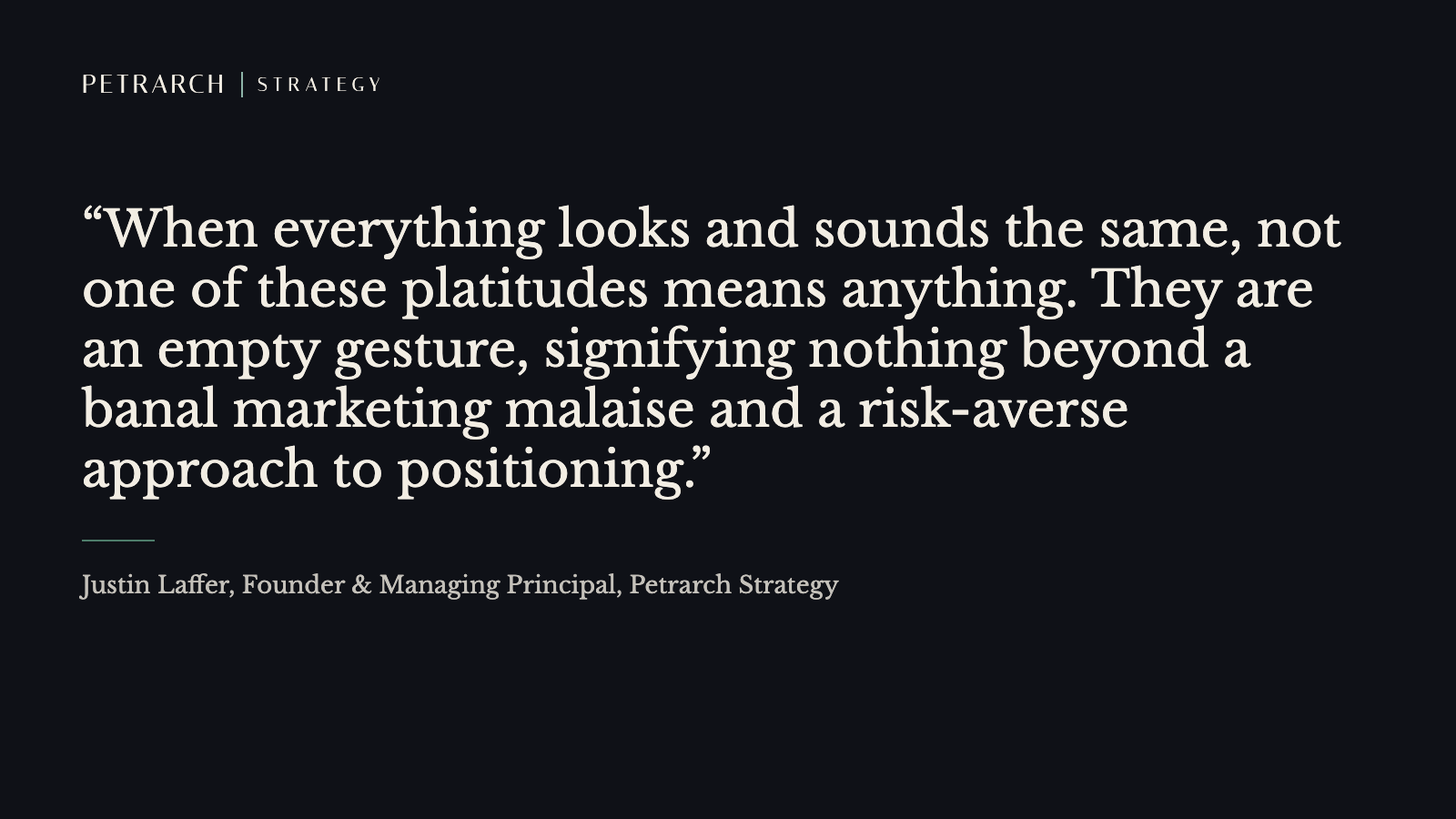
When everything looks and sounds the same, not one of these platitudes means anything. They are an empty gesture, signifying nothing beyond a banal marketing malaise and a risk-averse approach to positioning. Nobody on a buying committee can disagree with any of it, which is exactly why nobody can choose on it either. And when that committee has to cut, it cuts what it cannot describe.
Over fifteen years in healthcare marketing I have watched this sameness cycle feed on itself. An echo chamber of agencies, vendors and conference decks repeats the same lines until they stop registering, and then repeats them again. The cycle has a single source. The people producing the marketing do not actually know the business of healthcare. They do not know what a readmissions penalty does to a CFO's week. They have no idea what the people who chose this industry actually care about, or why they stayed.
If you do not know the business, you cannot write the detail that would prove you do. So the detail gets left out, and what goes in its place is the language that has been safe for a decade, tepid, facile and generic, copied from the last company that copied it. It is the marketing of a tourist, who learns a dozen phrases, says them loudly, and mistakes the polite smiles of the locals for fluency, when they could tell from the first syllable who has lived here and who is passing through. The echo chamber keeps the tourists supplied: agencies that serve every industry and treat healthcare as one more stop, in-house teams hired from outside it, and review cycles that sand off anything specific enough to be wrong.
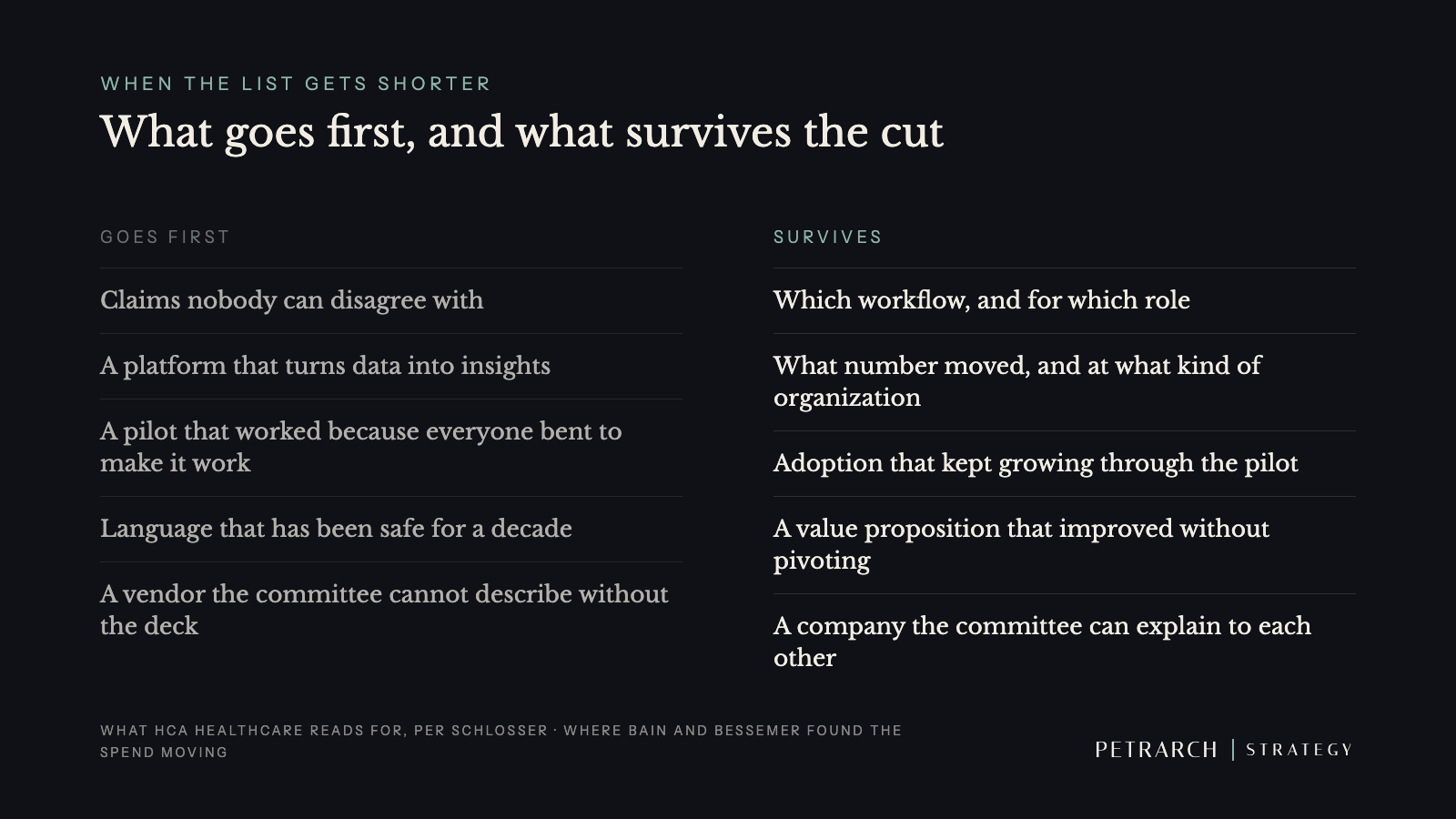
The companies that survive a consolidation are the ones a buying committee can explain to each other without pulling up the deck. That means claims a buyer can check. Which workflow, for which role, what number moved, at what kind of organization, and over how long. It means a writer who knows what the chief clinical officer is going to do with the email once he has read it. The Bain data points the same way. The spending moved to healthcare-specific vendors and to the incumbents, which are the two kinds of company a committee can already describe in its own words. There is a valuation point in here as well. A vendor the buyer cannot distinguish is a vendor the buyer can replace, and an acquirer will price that.